JMPD 10.7
“Before words became words,
the core trembled in silence.
When memory and emotion converged,
language first touched the world.”
Some lexemes were born from story.
Others still wait to be remembered.
This dictionary does not claim to hold every answer.
But it holds something rarer:
a space where meaning can breathe.
If you’ve ever paused at a manga panel,
wondering why a word felt heavier than its definition—
this book was made for you.
* To open the dictionary, please click the dictionay.
 -- A guide to reviving lost experiences
Although this is an online dictionary, it adopts the format of a printed one, aiming to be a resource that can be read and learned from. Entries are arranged in Japanese alphabetical order, allowing users to read through them continuously as if turning the pages of a book. We hope users will first glance through the content and later—recalling, "Come to think of it, I read about that somewhere"—return to read the entries more thoroughly. The dictionary includes many terms—such as slang, long phrases, and onomatopoeia—whose spellings are difficult to predict, even for native Japanese speakers. It contains approximately 10,000 words and phrases. 海外の日本語漫画ファンに体験を復活させる読本を目指しているが、日本の読者にも楽しんでいただける工夫をしている。語句の背景、どこから来て、どうしてそのような意味になったのか、漫画における伏線や回収となる語句・台詞、物語のテンポを速めたり、遅らせたり、静止させる言葉、ムードを一瞬に転換させる仕掛けや言葉、読者だけに伝える解説、期待や「イライラ」のビルドアップと解放・満足など、漫画家が仕掛ける漫画王道や画法も解説している。その他、楽しんで読んでいただける、読者の経験と語句が化学反応を起こす工夫もしている。読本のように、1ページ目から順に捲れる仕様。約一万語句を収録。
A Living Chronicle: This dictionary is woven to be read continuously, just like a manga tankobon. Each page is a "Magic Stone" detailing cultural lore, and the hidden "Treasure Chests" unveil iconic lines that shape the branch points of a story. For aspiring manga artists, this is an open blueprints mapping out the classic plot developments (Oudou), foreshadowing, payoff mechanics, and visual narrative techniques of Japanese Manga.Use the [ ← ] and [ → ] keys on your keyboard to flip through the abyss of layers smoothly. Tip: Press [ F11 ] anytime inside the dictionary to activate Full-Screen Mode. Shut out the external noise, and immerse yourself 100% into the silence of the zone.
Manga and Linguistic Structure / マンガと日本言語構造 :
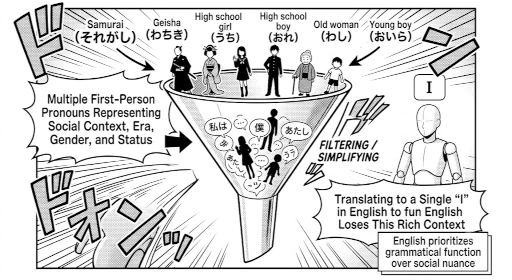 -- Many terms found in manga are difficult to translate directly. For instance, the Japanese first-person pronoun—which might simply be translated as "I" in English—includes a wide array of variants such as *wai*, *washi*, *watai*, *wachi*, *wachiki*, *wate*, *ware*, *kochitora*, *oira*, *ora*, *ore*, *uchi*, *atai*, *atashi*, *asshi*, *soregashi*, *sessha*, *wagahai*, and *shōsei*. These terms carry specific information shared between the author and the Japanese reader; from the pronoun alone, the reader can instantly discern details regarding the speaker's era, occupation, age, and gender. 漫画の語句に訳せないものが少なくない。例えば、英語では単に「I」と訳される日本語の一人称には、「わい、わし、わたい、わち、わちき、わて、われ、こちとら、おいら、おら、おれ、うち、 あたい、あたし、あっし、某(それがし)、拙者(せっしゃ)、吾輩(わがはい)、小生(しょうせい)」など。これらには日本語読者と共有されている情報が存在する。読者はこれらの名称だけで、時代、職業、年齢、性別などの背景を即座に識別する。(マンガと日本語 / Manga and Linguistic Structure)
 【Manga-Master Lexicon】marked with the magic stone aims to provide commentary that delivers a thrilling, privileged sense of insight—akin to reading between the lines—by revealing to the reader the very things that avid Japanese manga fans take for granted: the genre's established conventions and the hidden details (or core concepts) envisioned by the creators.
【MEANING】: A multifaceted explanation of the term's meaning, presented in a mix of English and Japanese.
【NUANCE IN MANGA】: An explanation of the term's "symbolic significance" within manga, as well as its role in foreshadowing or narrative payoffs.
【COMMON SCENES】: Examples of specific situations where the term appears. 【CULTURAL TRIVIA】: Etymology and origins, background specific to Japanese culture, alternative phrasings, and more.
【READERS' EXCITEMENT POINT】: Articulating the specific moment when a reader sees the term and thinks, "Here it comes(キタキタ)!"—capturing that surge of excitement.
【Manga-Master Lexicon】marked with the magic stone aims to provide commentary that delivers a thrilling, privileged sense of insight—akin to reading between the lines—by revealing to the reader the very things that avid Japanese manga fans take for granted: the genre's established conventions and the hidden details (or core concepts) envisioned by the creators.
【MEANING】: A multifaceted explanation of the term's meaning, presented in a mix of English and Japanese.
【NUANCE IN MANGA】: An explanation of the term's "symbolic significance" within manga, as well as its role in foreshadowing or narrative payoffs.
【COMMON SCENES】: Examples of specific situations where the term appears. 【CULTURAL TRIVIA】: Etymology and origins, background specific to Japanese culture, alternative phrasings, and more.
【READERS' EXCITEMENT POINT】: Articulating the specific moment when a reader sees the term and thinks, "Here it comes(キタキタ)!"—capturing that surge of excitement.
Sample entries from this book.
 うっそう
⇨うそぉ!? ⇨ひそひそ
うっそう
⇨うそぉ!? ⇨ひそひそ
Notes うそでしょう? Is it true? Gosh!, Really? 本当(ほんとう)?
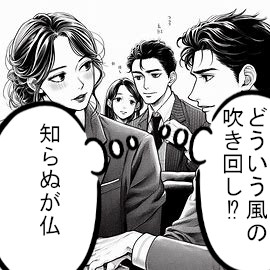 どういうかぜのふきまわし 「どういう風の吹き回し」 what brought this on? What's gotten into you to. ⇨ しらぬがほとけ 「知らぬが仏」。
Notes 知(し)らぬが仏(ほとけ)、風(かぜ)の吹(ふ)き回(まわ)し
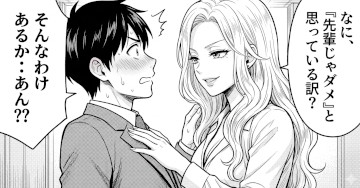 そんなわけあるか 「そんな訳あるか!」
No way!, That can't be true/right! That's impossible!
そんなわけあるか 「そんな訳あるか!」
No way!, That can't be true/right! That's impossible!
Notesそんな訳(わけ)あるか! ⇨ そんなことありえない。 先輩(せんぱい)、思(おも)う、訳(わけ)
manpu 「漫符」

-- more --
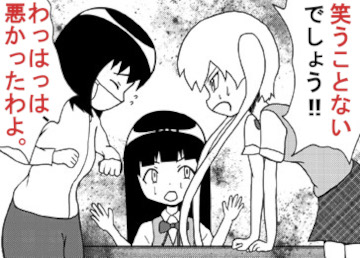 わっはっは
Bahahaha wahahaha
わっはっは
Bahahaha wahahaha
Notes わーはっはっは、Exciting laughter, guffaw, belly laugh 、悪(わる)かった、笑(わら)う
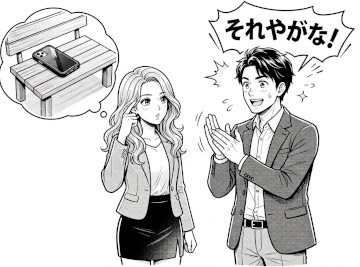 それやがな 【MEANING】 A Kansai dialect exclamation of violent agreement or conviction, meaning "That's the one「まさにそれだ」!" or "That's the exact answer I was looking for!" (equivalent to standard Japanese "Sore da yo「それだよ」"). It describes the electric moment of sudden clarity when a decisive opinion or a discovered clue fits into place like the final puzzle piece. [ENGLISH】 That's the one!, Bingo!, Exactly!, You nailed it! 【NUANCE IN MANGA】: In manga, "Sore ya gana「それやがな」" is not mere casual agreement; it symbolizes a resolution trigger (plot point) that instantly connects scattered foreshadowing and brings 100% clarity to the story's vision(「バラバラだった伏線(ふくせん)が一瞬(いっしゅん)で繋(つな)がり、物語(ものがたり)の視界(しかい)が100%クリアになる). In suspense and mind games, it acts as a checkmate signal uttered by a nonchalant Kansai character the moment they seize a breakthrough in deduction. In comedy and slice-of-life, it functions as an ignition plug that speeds up the scene's tempo when a character draws out the exact witty retort or logical point they needed. 【COMMON SCENES】: ...
Notes まさにそれだ、 それなんだよ。【CULTURAL TRIVIA】: Formed by combining the demonstrative pronoun "sore「それ」" (that), the Kansai assertion verb "ya「や」", and the particle "gana「がな」", which adds strong emphasis. The particle "gana" contains a slight nuance of friendly exasperation ("How did you not notice sooner?"), refined in manga as a sharp single phrase that shifts a stagnant room into instant resolution(「閉塞(へいそく)した空間(くうかん)の空気(くうき)を一瞬(いっしゅうん)で『解決(かいけつ)・納得(なっとく)』へ」). Manga substitutes include "Piercing the Core," "Puzzle Completion," and "That's Exactly It."
だといいがな [MEANING] A line spoken behind a composure and fearless smile to dismiss an opponent's optimistic forecast, relief from escaping a plight, or conviction of victory—feigning empathy on the surface while hiding the cold truth that reality is not so sweet(「現実(げんじつ)はそんなに甘(あま)くない」) and the next hell or trap is already in motion. [ENGLISH] I wouldn't count on it. / If only it were that simple. [NUANCE IN MANGA]: Symbolizes the destruction of false peace and the countdown to a second despair(「第二(だいに)の絶望(ぜつぼう)の秒読み(びょうよみ)」) in suspense, tactical battles, and death games. Spoken calmly while exhaling cigarette smoke or tipping a glass, instilling a spine-chilling tension(「背筋(せすじ)が凍(こお)るような緊張感(きんちょうかん)を植(う)え付(つ)ける言葉(ことば)」) and revealing a massive gap in information. [COMMON SCENES]: ... 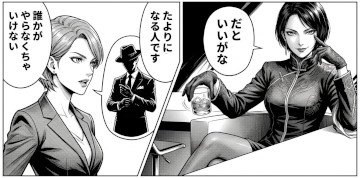
Notes そうだといいけど。[CULTURAL TRIVIA]: The Japanese sentence-ending particle "Gana「がな」" carries a nuance of wishful thinking or uncertainty. By posing objectively with "it'd be nice if that were so" rather than flatly denying it(「そうはならない」), the coldness of the line jumps, emphasizing the absolute superiority and cynicism of the strong(「そうは問屋(とんや)が卸(おろ)さない」). [READERS' EXCITEMENT POINT]: The spine-tingling realization that everything is still within the palm of their hand(「まだ裏(うら)があるぞ!」), erasing prior excitement and signaling the start of a deeper psychological battle. These words serve not to drive the user to despair, but as a resonant point that awakens a "resolute gaze"—one that enables them to navigate the cold, hard reality on their own terms, without being swayed by the sweet talk of others or by optimistic assumptions about the situation. [NEXT MOMENT]: .. 人(ひと)、誰(だれ)